
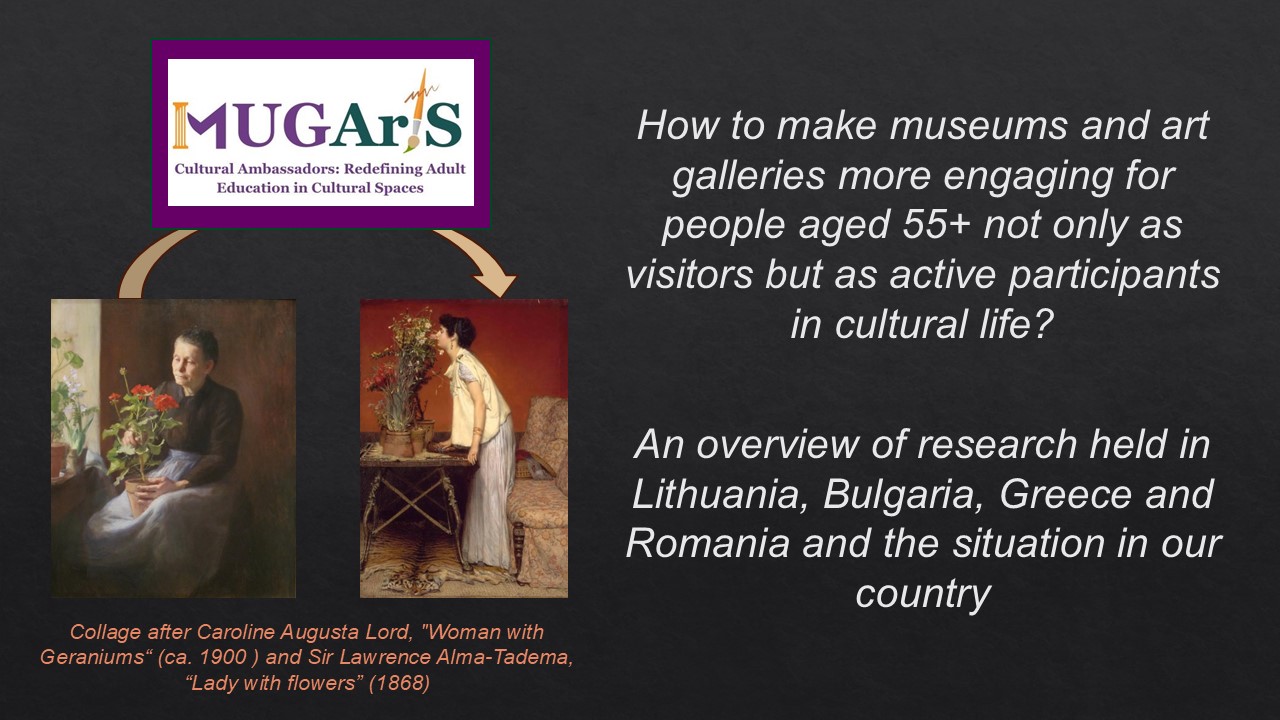
What experiences, barriers and needs adults and seniors have when visiting museums and art galleries? And how can people aged 55+ be engaged as active participants in cultural life?
These topics are in the focus of our project “Cultural Ambassadors: Redefining Adult Education in Cultural Spaces” (MUGArtS), (2025-1-LT01-KA220-ADU-000354739).
As a first step, we turned to people aged 55+ themselves and asked them to share their experiences in museums or galleries, how often they visit them, what the reasons to do so are, how welcome and included they usually feel, what would encourage them to visit museums or galleries more often, as well as what barriers and challenges they face and what needs and support they would like to receive. As the project aims to encourage seniors to become Cultural Ambassadors and to support other people their age to more actively engage with cultural life, we also asked them about what kind of participation would suit them best in a cultural activity and what training would be interesting and important for them.
The survey was held in March and April 2026 in the four partner countries. A total number of 114 people aged 55+ from big cities, middle-sized and small towns, as well as from villages and rural areas took part in it. Of them, 28 respondents were from Lithuania, 36 from Bulgaria, 25 from Greece and 25 from Romania.
From the shared experience and ideas for the attitudes in Bulgaria, we learned that:
- Most of respondents visit museums and art galleries quite often – at least once per month (30.60%), 2-3 times per month or at least 1-2 times per year. However, people who never went to cultural places were also involved – 8.30%, so as to consider their opinions as well.
- The strongest motivators for visiting museums and galleries were to enjoy art, culture, or heritage (66.70%), followed by wish to learn something new (52.80%), while the least important reasons were to socialise / spend time with others and to connect culture with their own life experiences (each collecting 16.70%).
- Shared availability of more relevant themes or exhibitions (41.70%) and more social or group-based events (36.10%) were stated as the most encouraging reasons for visiting museums and galleries more often.
- As the most common barriers were stated: physical accessibility (between 25% and 66.70% depending on whether it is a general reason or a personal barrier) and lack of time/other responsibilities (25%, as a personal barrier).
- Respondents shared that the most preferred formats of engagement with a cultural activity are listening and observing (75%) and discussing artworks with others (50%).
- As training formats, respondents preferred demonstrations with examples (55.60%) and hands-on / practical activities (47.20%).
- Most of the respondents shared that they would prefer a mix of online and face-to-face trainings (38.90%), followed by mostly face-to-face experiences in a group (33.30%).
If you like to explore the full results from the survey in Bulgaria, check out the report “How to make museums and art galleries more engaging for people aged 55+ not only as visitors but as active participants in cultural life – the situation in Bulgaria?”
If you like to see the comparative data for all four countries and where Bulgaria is, check out the joint report “How to make museums and art galleries more engaging for people aged 55+ not only as visitors but as active participants in cultural life? – an overview of research held in Lithuania, Bulgaria, Greece and Romania”
The project “Cultural Ambassadors: Redefining Adult Education in Cultural Spaces” (MUGArtS), (2025-1-LT01-KA220-ADU-000354739) is funded by the Erasmus + Programme of the EU.
 2025-1-LT01-KA220-ADU-000354739
Funded by the European Union. Views and opinions expressed are however those of the author(s) only and do not necessarily reflect those of the European Union or the National Agency. Neither the European Union nor National Agency can be held responsible for them.